It could have been a disastrous beginning. Laurie’s womanizing, alcoholic father walked out on her mother and her when she was five years old. They were living in a little white house on Bittersweet Lane in New Lenox, Illinois. While it was a great struggle, and money was always in short supply, Laurie’s mother was a hard worker who never accepted charity, and they managed to live a simple life in a series of too-hot-in-the-summer and too-cold-in-the-winter upstairs apartments in Joliet, Illinois. Her mom eventually met a wonderful man, fell in love and married. Things got quite a bit easier then, with two incomes in the household, and they even managed to buy property in a rural town called Plainfield upon which the family built a house with their own hands.
Laurie grew up surrounded by all kinds of music. Her step-father, who Laurie considers to be her “real Dad”, was a hard core country fan. Her mom listened to the lighter side of rock and pop, and Laurie was a typical midwest teenager who listened to all kinds of rock, pop, country, R&B, even disco. She absorbed it all…although she does remember her Dad actually banning her Kiss albums from the house! The one thing that was missing from that period is the blues. Even though Chicago was less than an hour away, in their tiny little microcosm of small town Illinois, Laurie was completely in the dark about the musical form that would soon shape her very existence.
Laurie’s best friend Brendan had an acoustic guitar. In the high school band, she played flute during concert season and drums during marching season, but this was totally different. Being curious, she gave it a try. She thought the guitar was “the greatest thing ever” and wrote her first song after learning only three chords. She was a busy kid in high school, as Laurie was also an accomplished athlete earning a total of 12 varsity letters during her four years and was eventually inducted into the school’s Athletic Hall of Fame.
At 18, she went off to the University of Illinois at Urbana-Champaign to get a degree in Electrical Engineering. She also attended the U of I’s Institute of Aviation, earning private, commercial, instrument and multi-engine pilot's licenses. Her sophomore year, she was running out of money fast and missing playing sports. She tried out for the volleyball team and won a full-ride volleyball scholarship. She now had a way to pay for her education and loved playing volleyball. She would always bring her acoustic guitar along on the team’s road trips and it was quite common for her to get the whole team singing while they were waiting for delayed flights to and from their games.
Laurie eventually bought herself an electric guitar, a beautiful, white Les Paul Custom with gold hardware and an ebony fretboard, which she says, “took everything I had and then some to buy.” Years later, it was sold for rent money back home while she was out on the road somewhere. Laurie laments that she still misses that guitar.
After graduating from college she took a job in aerospace and moved to Los Angeles, joining a rock & roll cover band as a rhythm guitarist and vocalist. It didn't take very long before she wanted to play lead guitar. Once she started, she progressed quickly due to her ability to practice for long, long hours and never get bored. “The guitar is so fascinating to me,” says Laurie, “an unending source of inspiration and wonder, something no mere human could ever master.” It was then that she got her first Stratocaster: “It was red and shiny and sexy, and I was home baby!” She quit her engineering job, never to return, and joined a road band as its lead guitarist/vocalist, doing Top 40 covers. They traveled around California and Nevada playing 5 nights a week in clubs, casinos, hotels, and every dive bar that would have them. Laurie would play guitar 4 to 5 hours every night at the shows and practice 3 to 4 hours every day in her hotel room. She was ravenous about that guitar.
In the very early stages of developing her guitar style, Laurie learned from the world’s greatest rock & roll players, nourished by the musical smorgasbord of their recordings. She couldn't get enough! All that intricate, detailed studying paid off, giving her the dexterity and vocabulary which allowed her style to develop organically its own unique voice. To Laurie, playing lead guitar is “a lot like doing a life-long dance of seduction with your true love. It's just as important to know when to shut up and listen as it is to hoot and holler, when to tease and when to please, when to be tough and when to be tender.”
Her musical performances were rooted in guitar-driven blues rock and southern rock as she was playing lead guitar and singing in a power trio. When she was introduced to the music of Stevie Ray Vaughan her whole life changed. She fell head-over-heels in love with Stevie's powerful, electric blues! He was also the gateway through which Laurie was introduced to a world of blues history she'd never been exposed to before. She says, “It was like being turned loose in an infinite, beautiful new universe!”
Once she started creating her own brand of red hot blues rock, she realized quickly that this was what she was born to do. Her guitar playing style sprang forth as an evolutionary leap into life from that primordial soup of electric blues, rock, and country she was listening to. She says, “Nothing had ever felt so real, so visceral, so expressive, so passionate, so sexual, so nurturing, so spiritual, so painful, so healing, so thrilling, so demanding, so all-encompassing and so perfectly suited to me. I genuinely feel most complete with my guitar in my hands and I don't expect that will ever change.”
The next step was to begin recording her own music. Recording was expensive so that meant raising funds which in turn meant having to work at something besides music while still pursuing music. A terrible and painful sacrifice, but there was no way to get around it. Laurie got a Master's Degree in Applied Mathematics and taught college math classes to raise recording money.
Her first album was Out Of The Woods in 1997, and the band was called Backroad Shack in those days. Laurie wrote all 10 songs. Second, in 2004, came Find My Way Home, where Laurie wrote 8 of the 11 songs and a name change to the Laurie Morvan Band. Her third CD, Cures What Ails Ya, was released in March of 2007, and came close to capturing the raw power, dynamics, versatility and passion of a Laurie Morvan Band live performance. Laurie wrote all 12 tracks on this one.
The release of that third CD was a turning point for the band, and a real highlight for Laurie was when Guitar Player magazine interviewed her for a two page feature article in their October 2007 issue. Next came an interview with Vintage Guitar magazine, a feature spot on Dan Aykroyd’s House of Blues Radio Hour with Kickin’ Down Doors chosen as the Blues Breaker Song of the Week, and a flood of great reviews and articles in DownBeat, Blues Revue, Modern Guitars, and others.
In February of 2008, the band advanced to the finals of the International Blues Challenge held in Memphis, TN. Their CD Cures What Ails Ya also made it into the finals (top 5) of the Blues Foundation’s Best Self-Produced CD competition. Out of 160 acts that fought their way through their own regional competitions and made it to Memphis, the Laurie Morvan Band was the only one to advance to the finals of both the live band and CD competitions. Through the exposure of the IBC they were able to make connections for touring in the Midwest, something they do regularly now.
For her fourth CD, Laurie made the decision to work with an outside producer for the first time, co-producing with Steve Savage (Elvin Bishop, Robert Cray). In 2009, Fire It Up! was released. A classy, blues statement which shows Laurie’s continued growth as a songwriter, producer and guitarist. Laurie wrote all 12 songs on Fire It Up! and on January 23, 2010, it won the Blues Foundation Award for Best Self-Produced CD at the International Blues Challenge. Once again the band was honored by the House of Blues Radio Hour when You Don‘t Know About Me was selected as the Blues Breaker Song of the Week.
A prolific writer with a seemingly unending source of inspired material, Laurie penned 11 new songs for her fifth CD, Breathe Deep, released June 12, 2011. Once again, Laurie took the reins of producer, this time co-producing with bandmate and record label partner, Lisa (Grubbs) Morvan.
The driving blues shuffle of No Working During Drinking Hours celebrates having some unapologetic fun in between all the hard work. Texas-styled Saved by the Blues paints a picturesque tale of meeting up with Robert Johnson at the crossroads one steamy summer night, and finding blues redemption. Mojo Mama grooves along on a funky, imagery filled journey deep into a sexy blues swamp. It Only Hurts When I Breathe burns slow and powerful, punctuated by beautiful guitar leads and an intimate, vulnerable vocal. Hurtin’ and Healin‘ highlights Laurie’s clever lyrics which explore the duality of the human condition via the coexistence, and codependence, of the two sides of every coin.
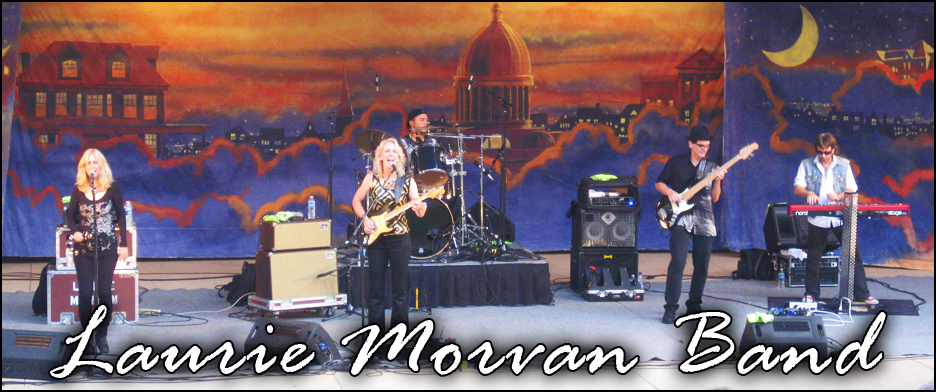
Laurie is a powerful, inviting and charismatic performer, whose personal, in between song banter alternates between inspirational and flat out hilarious. The band’s touring schedule continues to expand, with growing invitations to perform at festivals and special events all across the USA and into Canada such as: Thunder Bay Blues Fest, Billtown Blues Festival, Ellnora Guitar Festival, Blues by the Bay, Fire on the Mountain, SummerSounds, Monterey Bay Blues Fest, Long Beach Blues Fest, Coloma Blues Live and the Legendary Rythm & Blues Cruise.
Accessible and affable, Laurie spends hours meeting with fans after shows. She often speaks onstage about her belief that “music is the most healing force in the universe and that we, as musicians, have a sacred calling to get out there and share that love and healing with the good folks in this world.”
Laurie Morvan, Discography
Gravity, 2018, Laurie Morvan
Breathe Deep, 2011, Laurie Morvan Band
Fire It Up!, 2009, Laurie Morvan Band
Cures What Ails Ya, 2007, Laurie Morvan Band
Find My Way Home, 2004, Laurie Morvan Band
Out Of The Woods, 1997, Backroad Shack
|